Let’s be honest.
Most people try surveys the same way they try a new gym membership , high enthusiasm, low strategy. They sign up for one platform, complete a few surveys, get screened out five times in a row… and quit.
The common mistake?
Relying on one platform.
When you depend on a single site, your earnings feel random. Some days you get three surveys. Some days you get none. Some weeks you hit payout. Other weeks you’re staring at $3.47 and wondering why you bothered.
Single-site earnings feel inconsistent because they are inconsistent.
Survey platforms don’t owe you volume. They operate on quotas, demographics, and demand. If you don’t match what researchers are looking for that day, you’re out. No survey. No money.
That’s why treating surveys like a lottery ticket doesn’t work.
But treating them like a portfolio? That’s different.
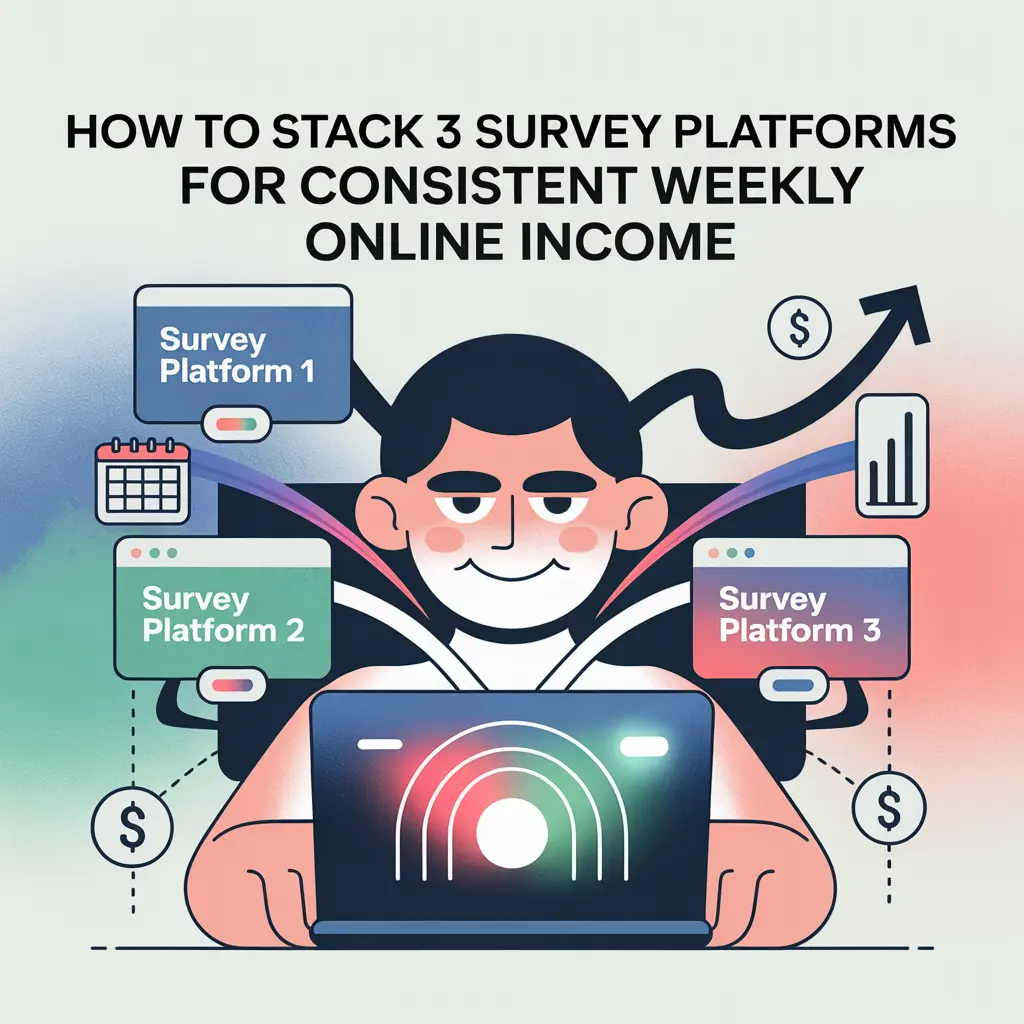
The core idea of stacking is simple:
You don’t depend on one stream. You combine several small streams so they add up to something steady.
Think of it like this:
- One platform = unstable trickle
- Three platforms = steady flow
- A system across all of them = predictable weekly cash
In this article, you’ll learn how to build a structured stacking system , one that turns scattered payouts into consistent weekly income instead of random pocket change.
No hype. No “quit your job” nonsense.
Just structure.
Set Realistic Income Goals First (Before You Stack Anything)
Before you stack, you need expectations that won’t sabotage you.
Surveys Are Supplemental , Not a Salary Replacement
Across personal finance blogs, side-hustle communities, and survey industry guides, the message is consistent:
Surveys are supplemental income.
Not a full-time replacement.
Not a $5,000-per-month business.
Not a path to early retirement.
They’re a micro-income stream.
That matters because unrealistic expectations kill consistency. If you expect surveys to replace your 9–5, you’ll burn out fast. If you expect them to cover groceries, subscriptions, or a utility bill? That’s achievable.
Frame surveys correctly and they become useful. Frame them incorrectly and they feel like a scam.
What “Consistent Weekly Income” Actually Means
When people stack multiple platforms strategically, realistic ranges often land somewhere between modest and meaningful.
For active users:
- Roughly $50–$250 per month is common depending on time, demographics, and country.
- That translates to about $12–$60 per week.
Not life-changing.
But consistent? Yes.
Now factor in effective hourly rate.
When you include screening questions and disqualifications, surveys often land somewhere around a low-to-mid single-digit hourly rate. That’s why stacking matters. You’re not chasing one $20 survey , you’re building volume.
Consistency doesn’t come from one high-paying opportunity.
It comes from structured repetition.
Reframe the Goal
Here’s the mental shift that changes everything:
Stop chasing one big payout.
Start stacking small wins.
Instead of asking:
“How can I make $100 today?”
Ask:
“How can I average $10–$15 per day across platforms?”
That’s the difference between frustration and sustainability.
Position surveys as:
- Coffee money → at minimum
- Subscription money → realistically
- Utility bill money → with discipline
When you think weekly, not randomly, surveys stop feeling pointless and start feeling predictable.
Why You Must Stack Multiple Survey Platforms
If consistency is the goal, stacking isn’t optional. It’s required.
The Dry Spell Problem
Most survey panels simply don’t send enough volume on their own.
You might get:
- 2–4 solid surveys per month
- Several that screen you out
- A few that disappear before you click
Screen-outs are part of the system. Researchers are targeting specific demographics. If you don’t match, you’re out , even if you spent five minutes answering qualifiers.
Relying on one platform means you feel every dry spell.
And dry spells destroy motivation.
Volume = Stability
More platforms = more available surveys.
Not because each one pays more , but because their opportunities don’t overlap perfectly.
When one platform is slow, another might be active.
When one screens you out, another might qualify you.
When one runs a promotion, another might be quiet.
Stacking reduces downtime.
And reduced downtime creates consistency.
It’s not about finding “the best survey site.”
It’s about combining several decent ones into a reliable system.
Different Platforms, Different Strengths
Not all survey platforms are built the same.
Some excel at:
- Quick 5–10 minute mobile surveys
Others specialize in:
- Longer, higher-paying studies
Some operate as:
- Multi-task or GPT portals with surveys plus extra earning options
And some are:
- Bonus-heavy ecosystems with streaks, multipliers, and contests
Stacking lets you combine strengths.
You use quick surveys to hit daily targets.
You use niche studies to boost weekly totals.
You use bonus platforms to accelerate payouts.
Individually, they’re inconsistent.
Together, they form a system.
And that system is where predictable weekly income begins.
The 3-Layer Stacking Framework
If surveys are a portfolio, this is your asset allocation.
Not random sign-ups.
Not chasing whatever email hits first.
A structure.
Three layers. Each with a purpose.
Layer 1: Core “Daily Driver” Platforms (2–3)
Role: Your consistency base
These are the platforms you touch almost every day.
They typically offer:
- Frequent, low-to-mid paying surveys
- Short polls or mini tasks
- Quick-win opportunities that pop up daily
They aren’t glamorous.
They aren’t high-paying per survey.
But they are steady.
This is your baseline income layer , the foundation that keeps money flowing even when everything else is quiet.
Think of these as your “daily reps.” Small actions, repeated consistently.
System for Using Them
Structure is everything here.
1. Fixed daily check times
Don’t refresh all day. That’s how burnout starts.
Check at set times , morning, midday, evening.
2. Small daily earnings target
Instead of chasing one big survey, aim for something like:
- $5–$10 per day across all core platforms
Hit the target. Log off.
3. Focus on speed and availability
These platforms reward responsiveness.
Quick clicks. Fast starts. Efficient completion.
The goal of this layer isn’t high hourly rates.
It’s dependable accumulation.
Layer 2: Niche / High-Value Panels (2–3)
Role: Your weekly income boosters
These platforms operate differently.
They usually send:
- Fewer surveys
- Higher payouts
- Studies targeted to specific demographics, professions, or behaviors
You won’t log into these daily and grind for hours.
Instead, they act like income spikes.
One qualified survey here can equal three or four from your daily drivers.
This layer is what pushes your weekly total from “decent” to “noticeable.”
System for Using Them
This is a precision layer.
1. Fully optimized profiles
Complete every demographic detail.
Update changes.
Match honestly and consistently.
High-value surveys are selective.
If your profile isn’t optimized, you won’t even see them.
2. Notifications turned on
These opportunities fill fast.
Email alerts or app notifications matter here.
3. Priority when available
If a high-value study hits, drop lower-paying work.
Take it first.
Treat this layer as “high-value first.”
Because it is.
Layer 3: Offer-Wall & Bonus-Heavy Platforms (1–2)
Role: Acceleration layer
This is where strategy meets leverage.
These platforms typically include:
- Streak bonuses
- Multiplier days
- Limited-time contests
- Extra microtasks beyond surveys
Individually, many tasks aren’t impressive.
But during promotions?
They can compress earnings into shorter timeframes.
This layer helps you:
- Reach payout thresholds faster
- Boost slow weeks
- Increase your effective rate during promo periods
System for Using Them
You don’t grind these every day.
You deploy them strategically.
1. Use during promo periods
Multiplier days and boosted payouts are when this layer shines.
2. Push toward payout thresholds
If you’re close to cash-out, use this layer to bridge the gap.
3. Leverage bonus stacking
Combine:
- Daily streak
- Promo multiplier
- Task completion bonus
Layering bonuses is how small tasks become meaningful.
How Many Platforms Should You Actually Use?
More isn’t better.
Smarter is better.
The Burnout Trap
Signing up for 20 platforms feels productive.
Until your inbox explodes.
Until you forget passwords.
Until you spend more time checking dashboards than earning.
Too many platforms create friction.
And friction kills consistency.
Burnout usually comes from over-expansion, not underperformance.
The Sweet Spot Formula
Here’s the structure that works without overwhelming you:
- 2–3 core daily platforms
- 2–3 niche/high-value panels
- 1–2 bonus-heavy platforms
Total active stack: 5–7 platforms
That’s enough diversification to avoid dry spells ,
without drowning in accounts.
This is the balance between volume and sanity.
Active vs Passive Accounts
You can register on more platforms than you actively use.
That’s fine.
But actively grind only your top-performing stack.
Keep others in reserve.
If a core platform slows down, rotate in another.
If a new high-value panel emerges, test it for 30 days.
But at any given time, your “active stack” should stay tight and intentional.
The Weekly Routine That Makes It Consistent
Consistency doesn’t come from motivation.
It comes from a schedule.
Time Blocking Strategy
A simple structure works best.
Morning (10–15 minutes)
Quick check of daily drivers.
Clear overnight surveys.
Hit small wins early.
Midday (15–20 minutes)
Mobile block.
Short surveys.
Mini tasks.
Evening (20–30 minutes)
Longer surveys.
High-value studies.
Bonus opportunities.
Total: Around 45–60 minutes per day.
Now scale it.
- 15 minutes/day → modest monthly totals
- 60 minutes/day across stacked platforms → significantly higher consistency
Time doesn’t just add up.
Structured time compounds.
Priority Rules (Income Optimization Order)
When multiple surveys are available, follow this order:
- High-value niche surveys first
Scarce. Higher pay. Limited spots. - Daily streaks and mini tasks second
Protect bonus eligibility. - Fill gaps with short surveys
Efficient, quick wins. - Push when near cash-out threshold
Psychological boost. Momentum matters.
This keeps your hourly return higher and your motivation intact.
Avoiding Burnout (So You Don’t Quit in Week 3)
Burnout isn’t about surveys being hard.
It’s about overdoing them.
Follow a few guardrails:
- Cap daily surveys
- Rotate platforms
- Set weekly earning limits
- Take one full day off
And remember this:
Slow stacking beats binge grinding.
One disciplined hour per day for 30 days
beats six chaotic hours on Saturday and nothing for three weeks.
Consistency isn’t sexy.
But it pays.
Profile Optimization: The Hidden Multiplier
If stacking is your structure, profile optimization is your leverage.
Most people focus on finding “better surveys.”
Few focus on becoming a better match.
And that’s where money leaks.
Why Most People Get Screened Out
Getting screened out isn’t random. It’s usually predictable.
Incomplete profiles
If you skip demographic sections, leave household questions blank, or ignore optional surveys that “don’t pay,” you’re reducing your visibility.
Platforms match you based on data.
No data = fewer matches.
Inconsistent answers
This is the silent account killer.
If you say you’re single on one platform and married with two kids on another, that inconsistency can follow you. Many panels use overlapping research networks.
Inconsistency leads to:
- More screen-outs
- Lower survey invites
- In worst cases, account flags
Accuracy isn’t just ethical.
It’s strategic.
Optimization Checklist
Treat your profile like an asset.
Here’s the simple system:
Complete all demographics
Every category. Every field. Even the boring ones.
Update life changes
New job?
Moved cities?
Got a pet?
Update across all active panels.
Stay consistent across platforms
Your age, job role, income range, household size , these should align everywhere.
Opt into areas you actually know
Tech, travel, finance, parenting, gaming, choose categories where you can answer confidently. Low-quality responses increase disqualifications long term.
Optimization doesn’t feel exciting.
But it quietly increases:
- Qualification rate
- Survey frequency
- Effective hourly return
It’s a multiplier.
Location & Demographic Advantage
Not all users earn the same , and that’s not opinion. It’s economics.
Geography matters.
Certain countries typically receive:
- Higher-paying studies
- Greater survey volume
- More niche opportunities
Markets with strong advertising demand tend to generate more research budgets.
Demographics matter too.
Niche traits can unlock better-paying surveys:
- Specific professions
- Health conditions
- Pet ownership
- Tech usage
- Household purchasing decisions
The more specific (and accurate) your profile, the more likely you are to match higher-value research.
Stacking works better when matching works better.
Tracking: The Difference Between Random and Predictable Income
If you don’t track, you’re guessing.
And guessing feels like randomness.
Tracking turns stacking into a system.
Why Tracking Changes Everything
Tracking does two critical things:
1. Turns guesswork into measurable ROI
You stop asking, “Is this worth it?”
You start knowing.
2. Identifies high-earning platforms
Not all platforms perform equally for you.
Some will quietly outperform others.
Without tracking, you’ll never notice.
With tracking, you optimize.
Simple Spreadsheet Framework
You don’t need fancy software.
A basic spreadsheet works.
Columns:
- Platform
- Date
- Minutes spent
- Reward value
- Status (pending, approved, paid)
- Notes (high screen-outs, great payout, promo day, etc.)
From there, calculate:
- Total monthly earnings
- Total minutes invested
- Effective hourly rate per platform
Now you’re not stacking blindly.
You’re allocating time where it pays best.
Monthly Platform Pruning
Here’s where discipline kicks in.
After 30 days:
- Drop platforms that consistently underperform
- Reduce time on high screen-out sites
- Double down on top earners
Stacking isn’t static.
It evolves.
Your portfolio should improve every month.
Cash-Out Strategy: Make It Feel Like Real Income
Earnings only feel real when they move.
Sitting as points in an account doesn’t build momentum.
Weekly vs Monthly Cash-Out Psychology
Weekly payouts create motivation.
When you transfer earnings every Sunday, you:
- See tangible progress
- Reinforce the habit
- Build momentum
Monthly cash-outs can feel distant.
Weekly ones feel alive.
Small wins compound psychologically.
Payout Threshold Strategy
Choose platforms strategically.
Favor:
- Lower payout minimums
- Clear redemption rules
- Reliable payment methods
Rotate cash-out schedules so something hits your account regularly.
Instead of one $120 monthly payout, you might see:
- $30 this week
- $45 next week
- $25 the week after
Momentum > waiting.
Reward Optimization
Not all redemption options are equal.
Some platforms:
- Offer better value per point for certain gift cards
- Reduce value for cash transfers
- Have expiration windows
Compare options.
Avoid letting points sit too long.
Optimization here can quietly increase total earnings without increasing time.
Red Flags and Scam Prevention
Stacking only works if the platforms are legitimate.
Unrealistic Income Claims
If a site promises:
“Hundreds per day for clicking surveys”
Run.
Surveys are supplemental.
Anything claiming extreme daily income is likely exaggeration , or worse.
Upfront Fees & Sensitive Data Requests
Legitimate survey platforms:
- Do not charge registration fees
- Do not ask for unnecessary sensitive data
- Do not request banking passwords
If something feels invasive or unrelated to research, skip it.
How to Vet a New Platform
Before adding a platform to your stack:
- Check community reviews
- Look for clear payout systems
- Review their privacy policy
- Confirm transparent reward structures
Treat new platforms like new investments.
Test small. Scale only if they perform.
Example Weekly Stacking Blueprint
Let’s make this practical.
Time Commitment:
60 minutes per day, 5 days per week.
Stack:
- 2 daily drivers
- 2 niche panels
- 1 bonus-heavy platform
Flow:
Morning (10–15 minutes)
Clear short surveys and daily tasks on core platforms.
Afternoon (15–20 minutes)
Mobile surveys and quick bonus tasks.
Evening (20–30 minutes)
Prioritize high-value studies and promo multipliers.
With this structure, realistic projections often fall somewhere in the range of:
- Roughly $50–$200+ per month
Depending on: - Location
- Qualification rate
- Consistency
Not explosive.
But steady.
And steady is scalable.
Final Takeaway: Stacking Is About Systems, Not Surveys
Surveys aren’t high-paying individually.
That’s the truth.
But consistency doesn’t come from one high-paying opportunity.
It comes from diversification.
When you:
- Stack multiple platforms
- Optimize profiles
- Track earnings
- Prioritize strategically
- Cash out intentionally
You transform random activity into predictable income.
Treat surveys like a micro-income portfolio.
Volume + structure + tracking = weekly predictability.
You don’t need one perfect platform.
You need a controlled system.
Build the system, and the income follows.

Leave a comment
Your email address will not be published. Required fields are marked *